Saturday, 19 September 2026
E-invoicing checklist for trade businesses in Germany: ready for 2027/2028
Note for businesses in Austria: This checklist refers to the legal situation in Germany (the German e-invoicing mandate under the Growth Opportunities Act, XRechnung/ZUGFeRD, GoBD). Austria has no general B2B e-invoicing mandate; e-invoices are currently only mandatory when invoicing the federal government (ER>B/Unternehmensserviceportal). Retention there is governed by sections 131 and 132 BAO.
We explained the basics of e-invoicing in Germany – what it is, which formats exist and why a PDF is not enough – in the article The German e-invoicing mandate: what trade businesses need to know now. This article is the practical part: a checklist you can use to check in half an hour whether your business is ready for 2027 and 2028. Print it out or go through it with your office – every open point is a concrete task.
To print and tick off: Download the checklist as a PDF (free, no sign-up; the PDF is in German).
The deadlines at a glance
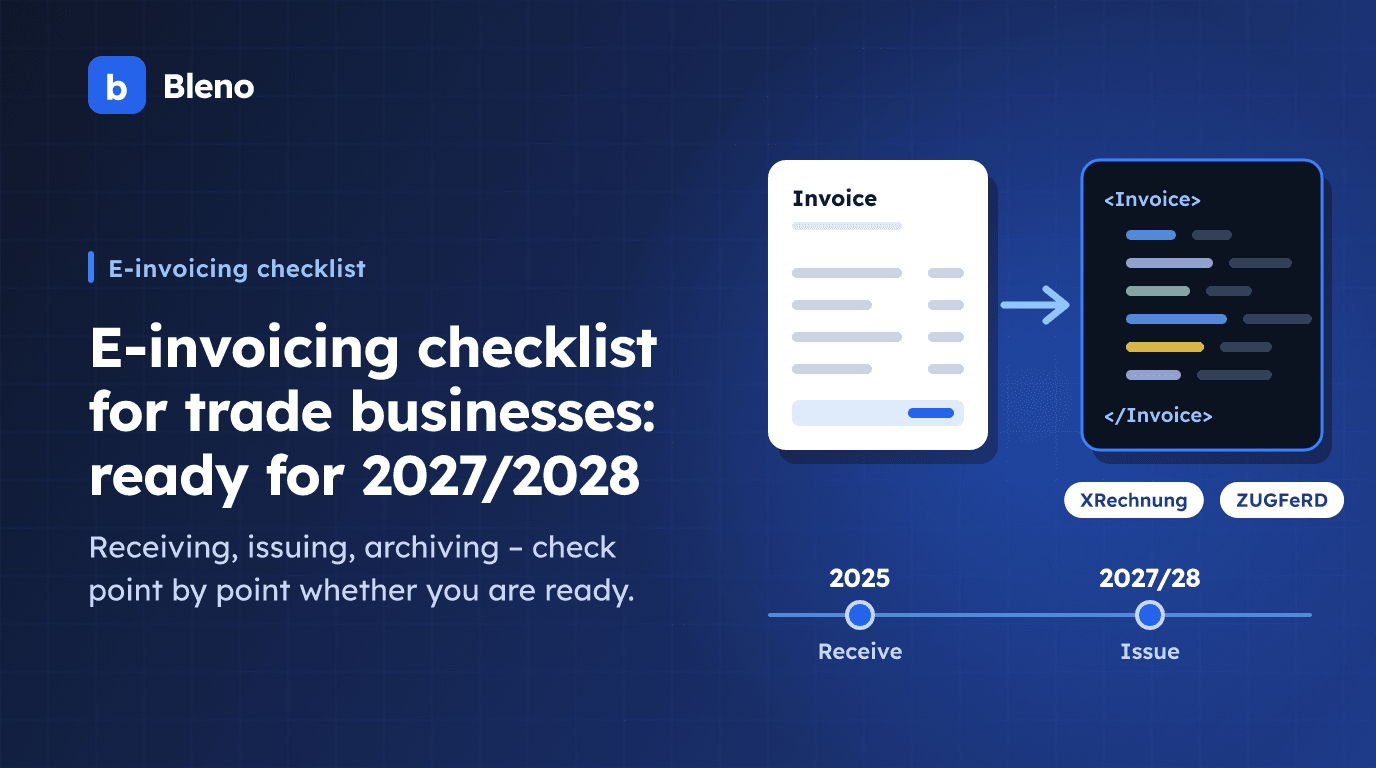
The e-invoicing mandate in Germany is being introduced in stages (as of September 2026):
| Since / from | What applies |
|---|---|
| 01.01.2025 | All businesses in Germany must be able to receive e-invoices in the B2B sector. |
| 01.01.2027 | Businesses in Germany with more than €800,000 turnover in the previous year must issue e-invoices. |
| 01.01.2028 | All businesses in Germany must issue e-invoices in the B2B sector. |
Until then, during the transition period, you may continue to send paper or PDF invoices to business customers, provided the recipient accepts them. Conversely: under German rules you may no longer refuse an e-invoice that a supplier sends you.
Important exemptions under German law:
- Private customers (B2C): Invoices to private individuals are not affected. If you work exclusively for private households, you don't have to issue e-invoices – but you must be able to receive them.
- Small-amount invoices up to €250 gross and travel tickets may still be issued as "other invoices" (paper, PDF).
- Small businesses under section 19 UStG (the German small business rule) are exempt from the obligation to issue e-invoices, but must be able to receive and retain them.
Legal details change; your tax adviser always has the final word. Use the checklist as the basis for your next meeting with your tax adviser's office.
Checklist part 1: Receiving (in force in Germany since 2025)
Receiving is the part many businesses underestimate – the obligation already exists, regardless of your turnover.
- We have set up an email address for incoming invoices (e.g. invoices@…) and communicated it to suppliers and subcontractors.
- We can open XRechnung XML and ZUGFeRD PDF files (the German e-invoice formats) and read their content – not just the PDF part, but the structured data.
- Incoming e-invoices are captured automatically (supplier, invoice number, amount, tax rate) instead of being typed in.
- Input tax deduction is checked against the structured data: are the tax number or VAT ID, date of supply and tax rate correct?
- E-invoices are assigned to the correct project or job so that job costing is accurate.
- Our tax adviser receives incoming invoices including the original XML, not just as a printout or scan.
- We have checked with our most important suppliers when they will switch to e-invoicing.
Checklist part 2: Issuing (from 2027 or 2028 in Germany)
- We know when the German obligation applies to us: previous year's turnover above €800,000 → 01.01.2027, otherwise 01.01.2028.
- Our invoicing software produces ZUGFeRD or XRechnung (the German formats) according to EN 16931 – without an add-on module and without manual XML editing.
- Our master data is complete: company name, address, tax number or VAT ID, bank details, contact details.
- For every business customer we have recorded whether they want ZUGFeRD or XRechnung – public-sector clients in Germany usually require XRechnung with a Leitweg ID (the German routing ID).
- Date of supply, description of services and line-item data are maintained correctly in the software, so that the mandatory details under section 14 UStG (German VAT Act) end up in the XML.
- We know how to produce partial, progress and final invoices as well as credit notes and cancellations as e-invoices.
- Attachments such as site measurements, time records or delivery notes are embedded in the e-invoice or sent with it.
- We have sent a test invoice to our tax adviser or a customer and obtained feedback.
- Our office staff know which customers receive e-invoices and how sending works.
Checklist part 3: Archiving and GoBD (German bookkeeping rules)
An e-invoice is a data record, not a sheet of paper. That changes how it has to be retained.
- We keep the XML file as the original – with ZUGFeRD, the German hybrid format, the embedded XML part counts, not the printout.
- Storage is unalterable and traceable (as required by the German GoBD): changes are logged and documents cannot be overwritten afterwards.
- The retention period is met – in Germany, for accounting records such as invoices, eight years since the Bureaucracy Relief Act IV (as of September 2026; previously ten years).
- Incoming and outgoing invoices are machine-readable and can be provided digitally during a tax audit.
- Our process documentation describes how invoices are received, processed and archived.
- We have a solution for transactions without an invoice: bank transactions still missing a document are checked regularly.
- Month-end closing works without collecting scraps of paper – more on this (for businesses in Germany) in the article Documents to your tax adviser without the shoebox.
Common mistakes
"We already send PDFs." A PDF without embedded XML is not an e-invoice within the meaning of the German law. From 2027 or 2028 it will no longer be sufficient in the B2B sector in Germany.
The XML gets deleted. Some businesses print the e-invoice, file the printout and delete the file. That means the original is missing – a problem in the event of a tax audit.
The obligation to receive is ignored. "We're under €800,000, so this only affects us in 2028" is only true for issuing invoices under the German rules. You have had to be able to receive them since 2025.
Master data is incomplete. If the customer's tax number or the date of supply is missing, the e-invoice will be generated but rejected by the recipient's system.
Small-amount invoices are misunderstood. The €250 threshold under German rules applies gross and per invoice – not per line item and not per customer.
Private and business customers are treated the same. If you don't record customers properly as private individuals or businesses, you will either send e-invoices unnecessarily or – worse – fail to send them where the German mandate requires them.
How Bleno covers the checklist
Bleno is built so that most of the points above are covered without extra effort:
- Issuing: Every invoice can be exported as ZUGFeRD or XRechnung for customers in Germany – included in every plan, with no extra module. Attachments such as site measurements or time records are embedded.
- Receiving: Incoming XRechnung XML and ZUGFeRD PDF files (German e-invoice formats) arrive from the connected mailbox directly in the incoming documents inbox. Bleno reads the structured data instead of estimating it via OCR, and assigns the document to the right project.
- Archiving: The XML is archived as the original in line with the German GoBD. Bleno shows for each month which bank transactions are still missing a document and, if you wish, automatically sends the monthly package to your tax adviser.
More about the features: E-invoicing in Bleno and Incoming documents. All features are included in every plan (see pricing).
Conclusion
E-invoicing in Germany is not a big change if you break it down into three blocks: receiving, issuing, archiving. If you go through the checklist today, you will have enough time before 2027 or 2028 to close open points calmly – and won't have to switch software in a hurry in December 2027.
Try Bleno free for 14 days and tick off the checklist without having to deal with XML files. Get started.