Monday, 2 March 2026
Updated on 20 October 2026
The e-invoicing mandate for trade businesses in Germany: what applies in 2025, 2027 and 2028
Note for businesses in Austria: This article describes the legal situation in Germany (the German e-invoicing mandate under the Growth Opportunities Act, XRechnung/ZUGFeRD). Austria has no general B2B e-invoicing mandate; e-invoices are currently only mandatory when invoicing the federal government (ER>B/Unternehmensserviceportal).
E-invoicing is here – and if you run a trade business in Germany, it affects you too. Since 1 January 2025, new rules have applied in Germany to electronic invoicing in the B2B sector. If you don't act now, you risk problems with customers, your tax adviser and the tax office. In this article you'll find everything you need to know as a tradesperson in Germany: deadlines, formats, obligations – and how to prepare without much effort.
What is an e-invoice?
An e-invoice is not simply a PDF sent by email. A genuine electronic invoice is a structured data format that can be read by machines. That means: the invoice number, line items, amounts and tax rates are held in a standardised XML format – not just as an image or text.
The two formats relevant in Germany are:
- ZUGFeRD – a hybrid German format that combines a human-readable PDF with machine-readable XML data. Ideal for trade businesses, because the invoice still looks the way it always has.
- XRechnung – a pure XML format used in Germany mainly in the public sector.
For most trade businesses in Germany, ZUGFeRD is the format of choice, because it can both be read by the customer and processed by the system.
Which deadlines apply?
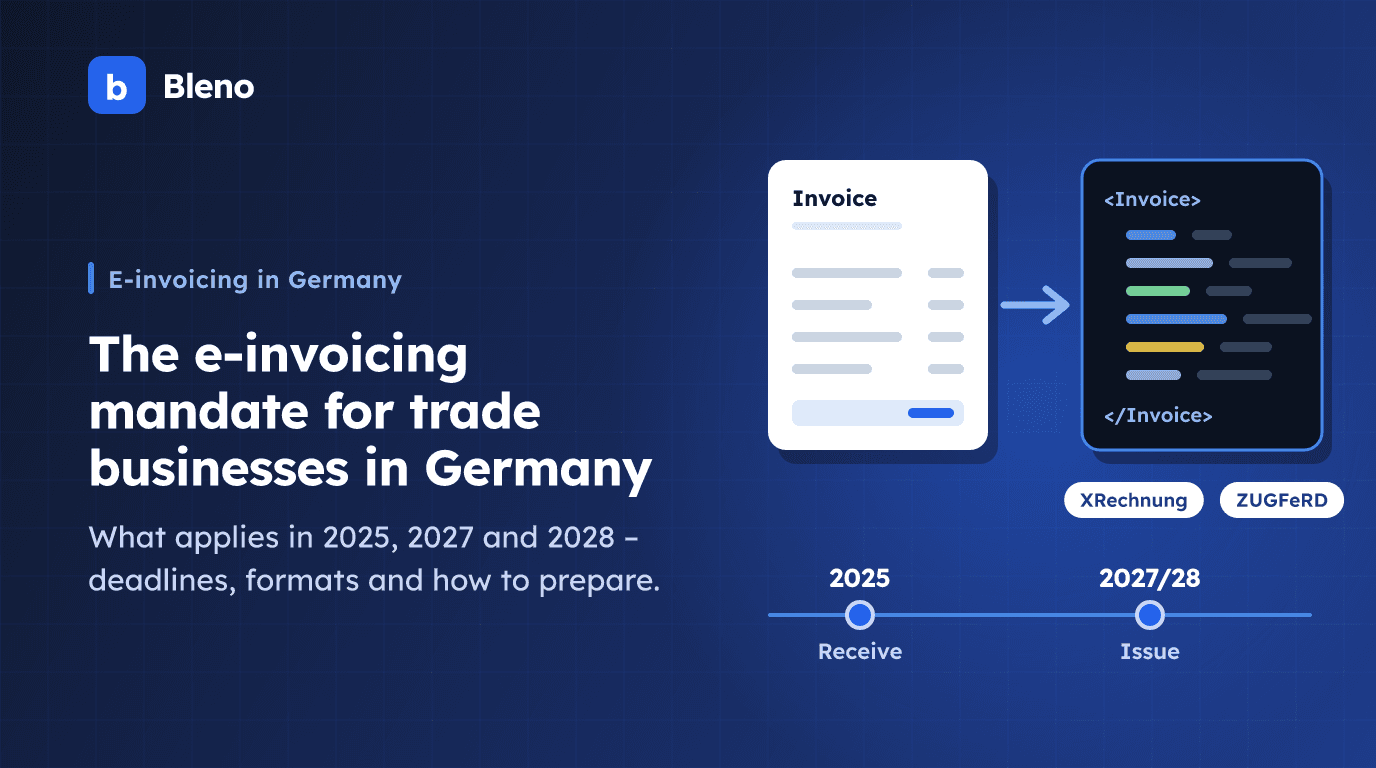
The German Growth Opportunities Act provides for a phased introduction:
| Period | Obligation |
|---|---|
| From 01.01.2025 | All businesses must be able to receive e-invoices |
| From 01.01.2027 | Businesses with more than €800,000 turnover in the previous year must issue e-invoices |
| From 01.01.2028 | All businesses must issue e-invoices |
Until then, transitional rules apply: until the end of 2026, all businesses may still send paper invoices or – with the recipient's consent – simple PDF invoices. Businesses with a previous year's turnover of no more than €800,000 may continue to do so until the end of 2027.
Important: since the beginning of 2025 you must be able to accept and process e-invoices from suppliers and subcontractors. A simple PDF is no longer enough for this. You can read how to capture and archive incoming invoices efficiently in the article on digitising incoming invoices.
Who is affected by the e-invoicing mandate?
The obligation applies to all B2B transactions between businesses established in Germany. As a trade business, you are affected if you:
- issue invoices to other businesses (e.g. main contractors, property managers, commercial clients)
- receive invoices from suppliers or subcontractors
Exception: invoices to private individuals (B2C) are exempt from the obligation. If you work exclusively for private customers, you don't have to send e-invoices for now – but you should still be able to receive them.
What happens if I do nothing?
If you ignore the deadlines, you risk concrete disadvantages:
- Input tax deduction at risk: invoices that don't meet the formal requirements can be challenged by the tax office.
- Losing customers: more and more clients – especially main contractors and public-sector clients – require e-invoices. If you can't provide them, you drop out of the running.
- Extra work with your tax adviser: non-compliant invoices lead to queries and corrections.
How to prepare your business
The good news: switching doesn't have to be complicated. Three steps are enough:
1. Check your current invoicing software
Can your current system create ZUGFeRD or XRechnung files (the formats used in Germany)? If you are still working with Word or Excel, it's high time for an upgrade.
2. Make sure you can receive e-invoices
Set up an email address or a system through which you can receive structured invoices. Your tax adviser can tell you which format they prefer.
3. Use software with built-in e-invoicing
The easiest way to switch is with software for trade businesses that already has ZUGFeRD, the German e-invoice format, built in. That way you create compliant invoices without having to deal with XML files.
E-invoicing with Bleno
Bleno supports ZUGFeRD-compliant e-invoices for businesses in Germany directly in invoice creation. That means:
- You write your invoice as usual – with line items, hourly rates and material costs.
- On export, a ZUGFeRD file (the German hybrid e-invoice format) containing all the structured data is generated automatically.
- Your customer receives a professional PDF that is machine-readable at the same time.
- The DATEV export for your tax adviser in Germany also works seamlessly.
No additional module, no extra cost – e-invoicing is included in every plan.
Conclusion: act now instead of retrofitting later
The German e-invoicing mandate isn't a thing of the future – it's already reality. If you prepare now, you save yourself stress, stay competitive and make a professional impression on clients.
Try Bleno free for 14 days and see how easy ZUGFeRD-compliant invoices for customers in Germany can be – get started.
More about the feature: E-invoicing in Bleno