Thursday, 26 March 2026
Updated on 20 October 2026
The skilled worker shortage in the trades: how digitalisation helps you keep your staff
The skilled worker shortage is the number one issue in the German trades. Businesses search for months for qualified journeymen and journeywomen, apprenticeships go unfilled and existing employees are working at their limit.
The causes are many: demographic change, workers moving to industry, the trades' lack of appeal to young people. As a single business, you can't change most of these causes. But you can make sure your business becomes more attractive than others – and that your existing employees want to stay. Digitalisation plays a bigger role in this than many people think.
Why employees leave trade businesses
Before we talk about solutions, it's worth looking at why skilled workers hand in their notice:
- Overload: too much work, too few staff, no prospect of improvement.
- Chaotic organisation: missing information, constant queries, unclear scheduling. Employees don't feel valued when the business seems disorganised.
- Lack of appreciation: no modern equipment, outdated processes, the feeling that the boss skimps on everything.
- No development: no new tools, no progress – the business feels like it's standing still.
- Work-life balance: overtime, weekend office work, always being reachable.
Many of these points are directly linked to the organisation and processes of the business – and that's exactly where digitalisation comes in.
How digitalisation helps in practice
1. Clear scheduling instead of chaos
If employees don't know in the morning where they're supposed to be going, if jobs are changed at short notice and the information doesn't get through, or if the boss gets called in the evening because nobody knows what's going on – then something is wrong with the planning.
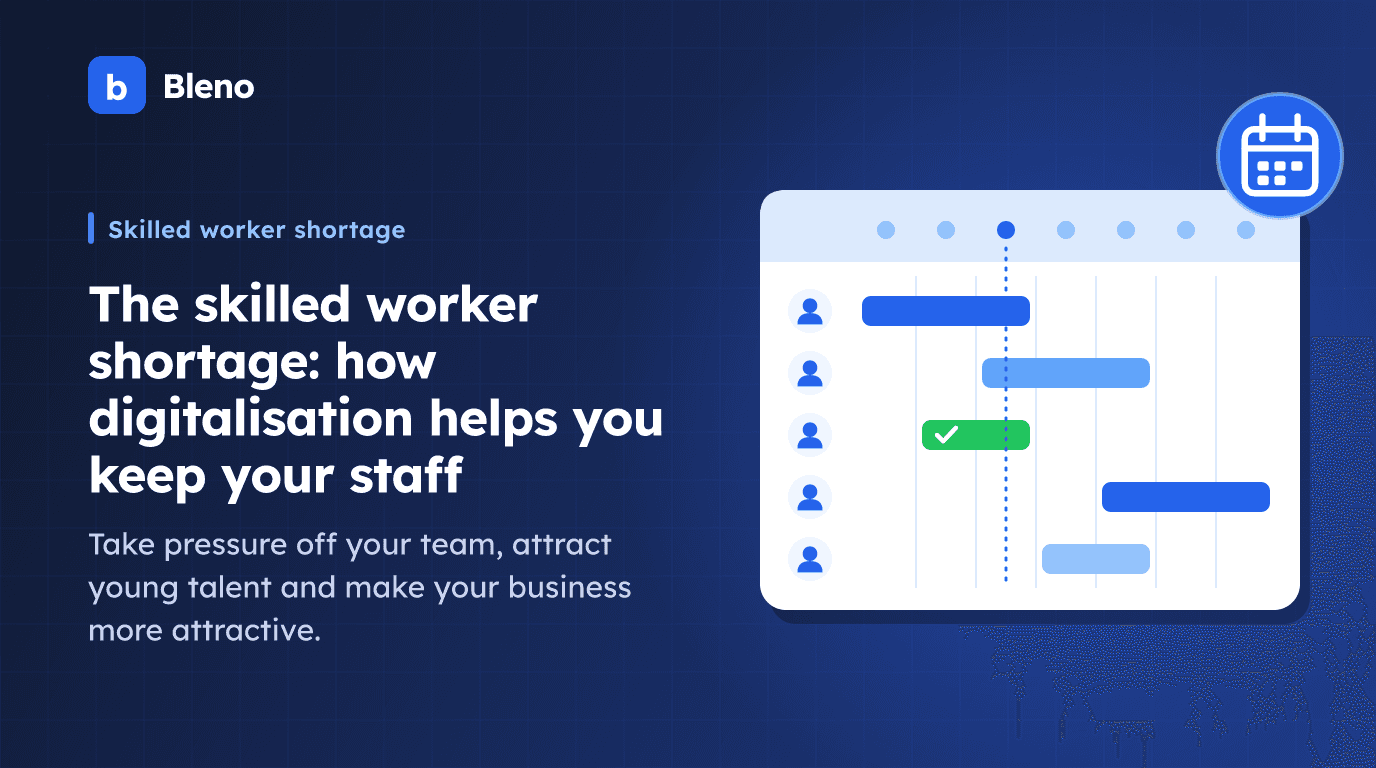
With digital team scheduling: every employee sees on their smartphone which assignment is coming up the next day – with the address, job details and contact person. Changes are updated in real time. No phoning around, no guesswork.
Effect on employees: less frustration, less uncertainty, more professionalism. Employees feel informed and taken seriously.
2. Less office work for the boss – more time for the team
In many businesses the boss spends the evening in the office: writing quotes, typing up time sheets, creating invoices. That means less time for leading employees, less time for winning new work, less time for themselves.
With digital processes: quotes are created in minutes instead of hours. Paper time sheets disappear because time tracking runs via the app. Invoices are created from quotes. The boss wins back hours every week.
Effect on employees: a boss who has time is a better boss. They can respond to problems, give feedback and lead the team – instead of drowning in paperwork.
3. A professional image for applicants
Young skilled workers and apprentices notice how modern a business is. A business organised with paper notes and WhatsApp groups doesn't look particularly attractive to the smartphone generation.
With modern software: you show applicants that your business works in an up-to-date way. It's not the main reason someone accepts a job – but it's a signal that can make the difference.
4. Transparent time tracking instead of mistrust
Paper time sheets create an unhealthy dynamic: the boss suspects the hours are being padded. The employees feel monitored. Both sides are unhappy.
With digital time tracking: recording is objective and transparent. No arguments about hours, no suspicion. That noticeably improves the working atmosphere.
5. Less overtime through more efficient processes
When processes run better, less gets left undone. When less is left undone, there is less overtime. When there is less overtime, employees are happier and healthier.
A concrete example: a business that digitises the transfer of time sheets saves 3–5 hours a week. A business that creates quotes from master data instead of Word templates saves another 2–3 hours. Those are hours nobody has to sit through late in the evening any more.
Digitalisation as an argument in job interviews
In a market where skilled workers can choose their employer, soft factors count. Imagine saying this in a job interview:
"Here you record your hours in the app – no paper. You see your schedule on your smartphone. You take photos on site directly in our app, with an automatic timestamp. And I'm not in the office in the evenings – I have time for my team."
That sounds like a business people enjoy working for.
What digitalisation does NOT solve
Honesty matters: digitalisation is not a cure-all for the skilled worker shortage. It doesn't replace fair pay, good leadership or a respectful working culture. But it lays the foundation for these things to become possible – because it frees up time, reduces chaos and conveys professionalism.
Bleno: digitalisation that works in everyday life
Bleno was developed to make everyday work in trade businesses simpler and more structured:
- Team scheduling: clear scheduling, viewable on the go
- Time tracking: via app, with DATEV export for German tax advisers
- Quotes & invoices: in minutes instead of hours
- Site documentation: photos, reports and records in one app
- Job costing: planned vs. actual for every project
Everything in one system – all features in every plan (see pricing). No IT degree needed, no months-long roll-out.
Make your business more attractive – for existing and new employees. Try Bleno free for 14 days. Get started.