Friday, 6 March 2026
Time tracking in the trades: obligations, methods and digital solutions
Note for businesses in Austria: This article describes the legal situation in Germany (the BAG ruling, the German Working Hours Act). In Austria, the Working Hours Act (AZG) and the Rest Periods Act (ARG) apply – the obligation to record working hours has existed there for a long time under section 26 AZG.
For many tradespeople, time tracking is one of the least popular tasks. Filling in timesheets, handing them in, collecting them, typing them up – a process that costs time instead of saving it. At the same time, the obligation to record working time in Germany has been clearer than ever since the 2022 BAG ruling. In this article you will find out what applies legally in Germany, which methods exist and why digital time tracking via an app is the most sensible solution for trade businesses.
The legal situation in Germany: time tracking is mandatory
In September 2022, the German Federal Labour Court (Bundesarbeitsgericht, BAG) ruled: employers in Germany are obliged to record their employees' working hours systematically (BAG, decision of 13 September 2022 – 1 ABR 22/21). This decision is based on a 2019 ruling by the European Court of Justice and applies to all sectors – including the trades.
What does this mean in concrete terms for businesses in Germany?
- The start, end and duration of daily working time must be recorded.
- The recording must be reliable and accessible – a slip of paper in a drawer is not enough.
- Breaks and overtime must be documented.
- The records should be kept – the planned amendment to the German Working Hours Act provides for a period of at least two years for this.
So far, the German Working Hours Act (ArbZG) only requires overtime to be recorded. Because of the BAG ruling, however, the recording obligation in Germany already applies comprehensively today – regardless of company size. The exact requirements on form and retention (such as electronic recording and the two-year period) are to be set out in a planned amendment to the German ArbZG, which, as of 2026, has not yet come into force.
Why time tracking is particularly challenging in the trades
Unlike in an office, tradespeople rarely work in one fixed place. The typical challenges:
- Changing sites: Employees are somewhere different every day. Who checks when someone started?
- No fixed desk: Timesheets are filled in on site – in the rain, with dirty hands, between two tasks.
- Crew work: Several employees work together. Does each person record their own time, or does the crew leader record it for everyone?
- Travel time: Does the journey to the site count as working time? How is it recorded?
- Network problems: Many sites have no stable internet.
This reality makes traditional methods such as paper timesheets or spreadsheets particularly error-prone.
Methods compared
Paper timesheets
The classic: every employee fills in a slip every day.
| Advantages | Disadvantages |
|---|---|
| No technical knowledge needed | Illegible, easily lost |
| No software costs | Has to be transferred manually |
| No real-time overview | |
| Errors and manipulation possible | |
| Office time required: 2–4 hours/week |
Spreadsheets
One step further: employees or office staff enter times in spreadsheets.
| Advantages | Disadvantages |
|---|---|
| Flexible and free | No mobile recording |
| Formulas possible | Error-prone with manual entry |
| No assignment to projects | |
| No DATEV export for German tax advisers | |
| Version chaos with several files |
Digital time tracking via app
The modern solution: employees record times directly on their smartphone – per project, with a GPS timestamp and automatic synchronisation.
| Advantages | Disadvantages |
|---|---|
| Recording in seconds, directly on site | Monthly software costs |
| Automatic assignment to projects | Employees need a smartphone |
| Real-time overview for the boss | |
| Time tracking offline (transferred once connected) | |
| DATEV export for German tax advisers | |
| Tamper-protected records | |
| No transferring, no typing up |
What a good time-tracking app should be able to do
Not every app suits the trades. Look out for these functions:
- Project-based recording: It must be possible to assign times to a site or a job – for job costing and invoicing.
- Offline capability: There is often no signal on site. The app must store times locally and synchronise them later.
- Easy to use: Your employees are tradespeople, not IT experts. Two taps to start, two to stop – it should not take more than that.
- Crew recording: The foreman can enter times for the whole team.
- DATEV export (for businesses in Germany): Your German tax adviser will thank you. No more manual transferring.
- Overtime and breaks: Automatic detection and display in line with the German Working Hours Act.
Time tracking with Bleno
Time tracking in Bleno was developed specifically for everyday site work:
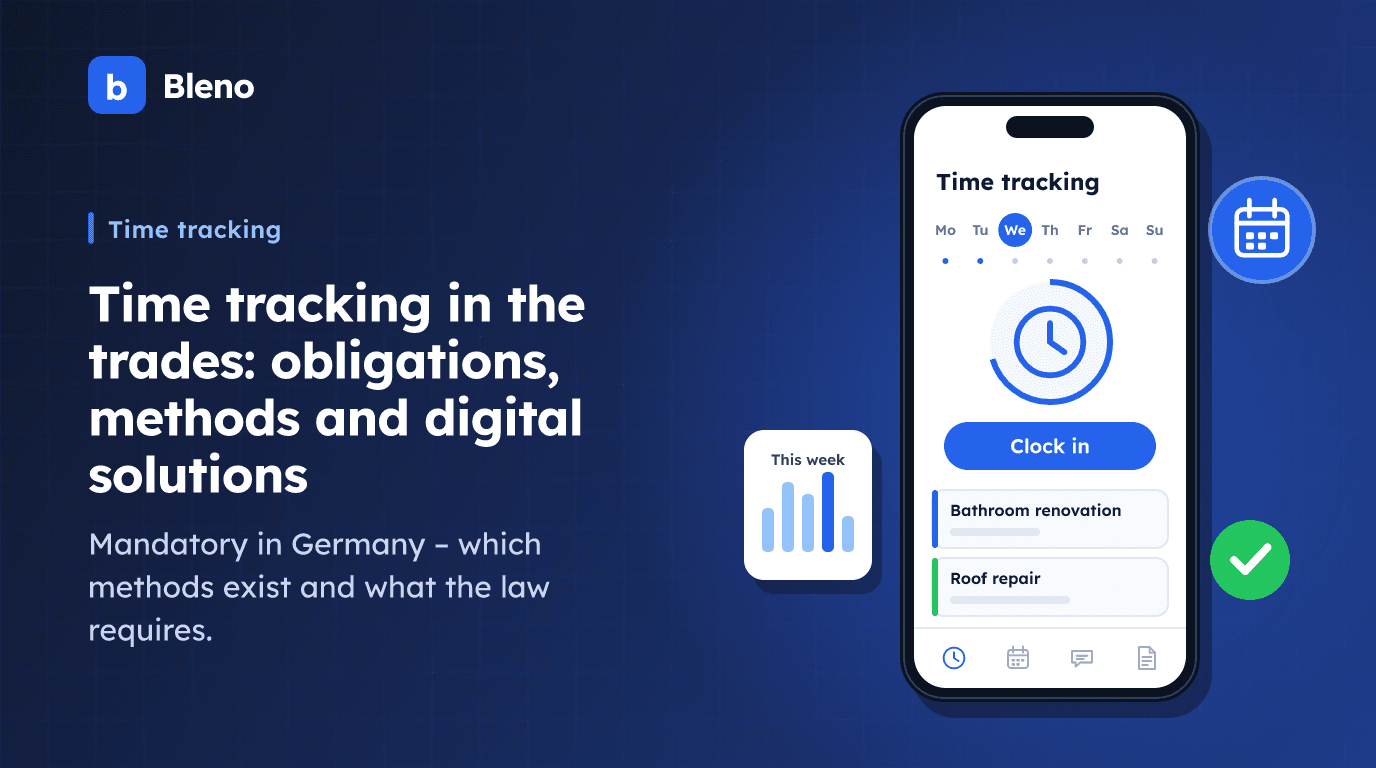
- Mobile app: Your employees start and stop time tracking directly on their smartphone – with two taps.
- Offline time tracking: Timer and time entries also work without reception. As soon as there is a signal again, the bookings are transferred automatically – with the time at which they were tapped.
- Project-based: Every hour recorded is assigned to a job. That way you always know how many hours each project has used.
- DATEV export for businesses in Germany: Working hours can be exported directly in a DATEV-compatible format – ready for your German tax adviser.
- Real-time overview: In the dashboard you can see straight away who is working where and how many hours have been logged.
- Integrated: Time tracking is not a separate tool but part of the overall solution – together with quotes, invoices, scheduling and site documentation.
Conclusion: meet the obligation and benefit at the same time
Time tracking is not just a legal obligation – it is a tool that helps you make your projects more profitable. If you know how many hours a job really took, you can estimate better, quote more precisely and spot loss-making projects early.
In our experience, switching from timesheets to an app saves a 5-person business 3–5 hours of office work per week – time you can put to better use. Five practical examples from the trades show what this looks like in practice.
Try Bleno's time tracking free for 14 days – even without reception on site. Get started.