Friday, 27 March 2026
Material management in the trades: control costs, avoid surprises
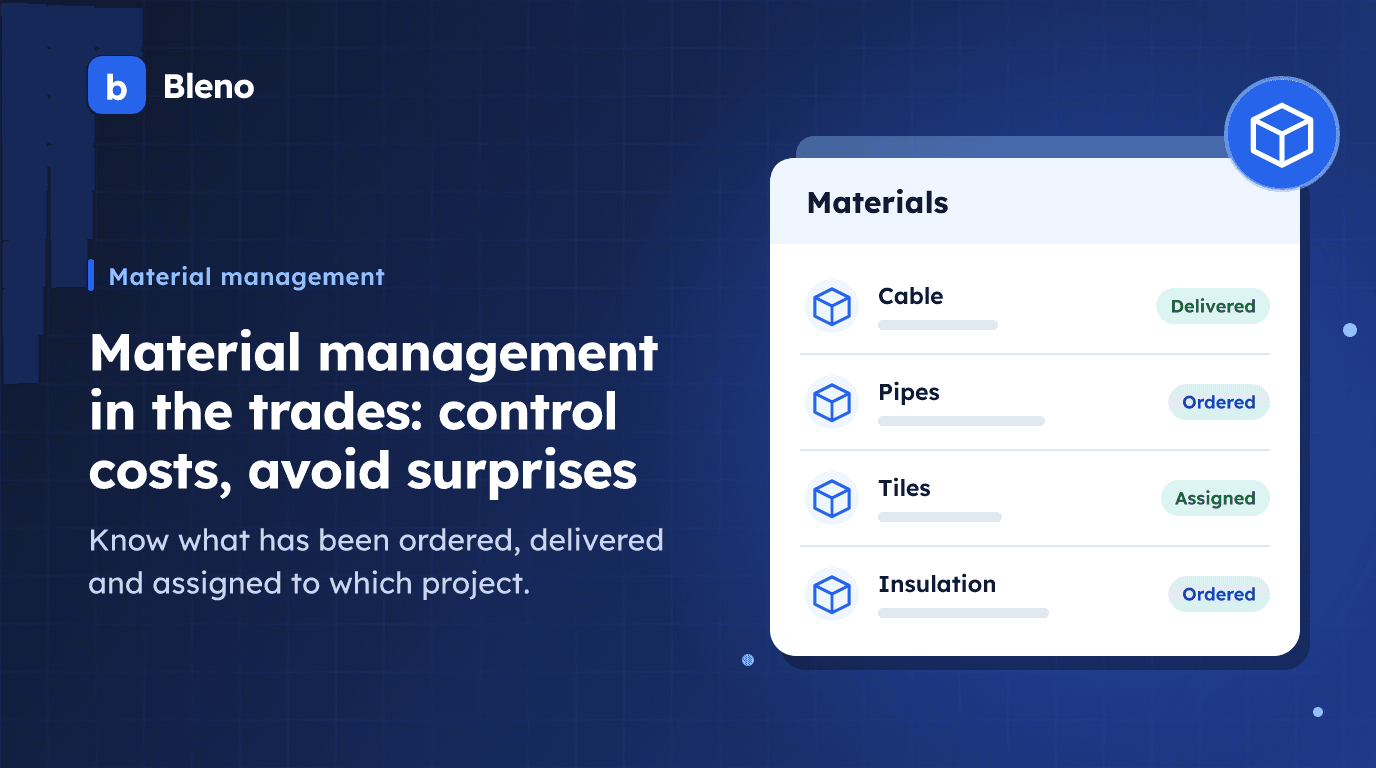
In many trade businesses, materials account for 30–50% of project costs. And yet material consumption is barely monitored in many companies – materials travel from site to site, orders end up in the accounts as a lump sum, and only during job costing does it turn out that the job hardly made any money.
That is not fate – it is a solvable problem.
Why material costs are so hard to control
Problem 1: No link to the project
Material is ordered, arrives on site and gets installed – but nobody noted that these 40 kg of screws were for the Müller project and those 12 cable reels for the Weber project. At the end of the month there is a collective invoice, and nobody can say any more which material went where.
Problem 2: Leftovers get passed along
Material is left over on site A. It goes back to the store or, more often, straight to site B. In the accounts, however, it was charged to project A. Project B benefits – at the expense of project A.
Problem 3: Duplicate orders
Because nobody knows what is still in stock, more gets ordered. Only later does the original material turn up again. Capital is tied up in the store, and the money is missing elsewhere.
Problem 4: Nothing to compare against
€3,500 of material was estimated. €4,800 was actually installed. Why? Without recording materials per project, that question cannot be answered – and the same mistake is repeated on the next similar job.
How digital material management changes this
Digital material management means: every item of material is linked to a project. Who ordered what, when it was delivered, which job it belongs to – all of this is traceable, can be analysed and can be compared with the estimate.
5 practical use cases
1. Assign material to the project when you order it
When you create an order or book in a supplier invoice, the material is assigned to a project straight away. That leaves no grey area between ordering and installing.
Example: An electrician orders 200 m of cable for the Ringstraße new-build project → in Bleno, the order is assigned directly to that project.
2. Planned vs. actual comparison for material costs
The quote contains a material estimate. The actual material costs from orders and supplier invoices are automatically set against it.
| Material | Estimated | Actual | Difference |
|---|---|---|---|
| Copper pipe DN 22 | €380 | €420 | +€40 |
| Fittings | €210 | €190 | -€20 |
| Insulation material | €560 | €680 | +€120 |
| Total | €1,150 | €1,290 | +€140 (+12%) |
This is not just a look back – it is an early-warning system. If material costs get out of hand halfway through a project, you see it in time.
3. AI recognises material from supplier invoices automatically
When a supplier invoice arrives as a PDF, Bleno uses AI to extract items, quantities and prices automatically. The material no longer has to be entered by hand – it only needs to be assigned to the right project.
If you receive a lot of supplier invoices, this saves valuable time every day.
4. Take material from the supplier catalogue straight into the project
Instead of typing in item numbers and prices manually, you can pick material directly from the imported supplier catalogue. Prices are up to date, item descriptions are correct – and the quote contains no typos in order numbers.
5. Material overview per project at a glance
If you want, you can see for each project at any time:
- What has been ordered so far, and at what price?
- What is still in stock or on its way?
- How much material has been used compared with the quote?
That creates transparency – for the owner, for the project manager and for the job costing later on.
What material management has to do with job costing
Material management is not an isolated function. It is the basis for meaningful job costing.
If you do not know how much material was used per project, you cannot judge whether the job was profitable. If you compare the quote with the actual costs, you spot patterns: where are material costs systematically underestimated? Which types of job regularly overrun on materials?
These insights make future quotes more accurate – and jobs more profitable.
Conclusion: material costs under control
Material management is not a time-consuming extra task. It is the result of one simple habit: assign material to a project when it is ordered or delivered.
What this habit pays back: projects where material costs are predictable. Quotes based on real experience. And bookkeeping that holds no more surprises.
Try Bleno free for 14 days and keep your material costs under control. Get started.
More about the feature: Material management in Bleno