Wednesday, 30 September 2026
Equipment inspections for trade businesses in Germany: inspecting ladders, electrical tools and vehicles on time
Note: This article gives an overview of the legal situation in Germany (as of September 2026) and is not legal advice. As the employer, you determine which inspections your work equipment needs and at what intervals in your risk assessment – supported by your occupational safety specialist and your Berufsgenossenschaft (the German statutory accident insurance institution for your trade).
Every trade business has dozens of pieces of work equipment that need regular inspection: leaning ladders and step stools, hammer drills, cable reels and extension leads, safety harnesses, the vans in the yard. Usually someone knows roughly when each item was last checked. After an accident at the latest, "roughly" is no longer good enough. In this article you'll learn which rules apply in Germany, which intervals are common in practice and how to keep track.
The basis: the German Ordinance on Industrial Safety and Health
The central regulation in Germany is the Betriebssicherheitsverordnung (BetrSichV), the German Ordinance on Industrial Safety and Health. Two sections are decisive:
- Section 3 – risk assessment: as the employer, you determine the type, scope and intervals of the required inspections for your work equipment. For most work equipment, the ordinance itself does not set fixed intervals. You base them on manufacturer information, the German Technical Rules (TRBS), regulations and information from the DGUV (the German Social Accident Insurance) and your own experience – for example, how heavily a device is used and how often defects turn up during inspections.
- Section 14 – inspection of work equipment: work equipment whose safety depends on the conditions of installation and use, or which is exposed to damaging influences, is inspected by a person qualified to carry out inspections. The result is recorded and kept at least until the next inspection.
So the intervals from the risk assessment are not optional, but they are not rigid either: you justify them for your business and document them.
Ladders and step stools
Ladders are among the most common causes of accidents in the trades. The German DGUV Information 208-016 ("Guidance on handling ladders and step stools") describes what matters:
- Regular inspection by a qualified person. You set the interval in your risk assessment; in practice annually is common, more often where ladders are used heavily on building sites.
- Visual check before every use by the user: are the stiles and rungs bent or cracked? Are the feet, hinges and spreader in order? A damaged ladder is withdrawn from use immediately and marked.
Proven in practice: give every ladder a number, so that inspections and defects can be assigned unambiguously.
Portable electrical equipment
For drills, angle grinders, extension cables, site distribution boards and chargers, DGUV Regulation 3 ("Electrical installations and equipment") applies in Germany. Its implementation guidance gives reference values for the repeat inspection of portable electrical equipment:
- Building sites: 3 months
- Workshop and production: 6 months
- Office and similar conditions: up to 24 months
These are reference values under the German DGUV rules, not rigid mandatory intervals. If inspections show hardly any defects over a long period, the intervals can be extended within justified limits; if the defect rate is high, they must be shortened. What matters is that you record your intervals in the risk assessment.
Inspections may be carried out by a qualified electrician or an electrically instructed person, provided they use suitable measuring and test equipment and work under the supervision of a qualified electrician. The inspection includes a visual check, measurements – for example of protective conductor and insulation resistance – and a functional test according to the relevant VDE standards. A quick glance at the cable is no substitute.
Personal fall protection equipment
Safety harnesses, lanyards, energy absorbers and retractable fall arresters must be inspected according to the manufacturer's instructions, but at least once a year, by a competent person. In addition, the user carries out a visual check before every use. Equipment that has arrested a fall is withdrawn immediately and only used again after release by a competent person. Many parts also have a service life limited by the manufacturer.
Company vehicles in Germany: UVV inspection and main inspection
For vehicles in Germany, two inspections run side by side and are often confused:
- UVV inspection under DGUV Regulation 70 (German accident prevention rules): vehicles are inspected at least once a year by a competent person for safe operating condition. It is an occupational safety obligation in Germany and independent of the main inspection.
- Main inspection (Hauptuntersuchung, HU) under section 29 StVZO (German Road Traffic Licensing Regulations): for cars and vans up to 3.5 t, the interval is usually 24 months; for new cars the first main inspection is due after 36 months. The sticker on the number plate is what counts.
Both dates belong in your calendar separately – passing the main inspection does not replace the UVV inspection required in Germany.
Documentation and consequences after an accident
Every inspection is documented: which device, when, by whom, with what result, and which defects were found and remedied. For electrical equipment, an inspection sticker on the device has also proven useful.
If an accident involving work equipment occurs in Germany, the Berufsgenossenschaft and possibly the public prosecutor will ask exactly about this. Missing records can be expensive: in cases of gross negligence the Berufsgenossenschaft can seek recourse, breaches of the German BetrSichV can be punished as administrative offences, and insurers also look closely. The real problem, though, is usually not the missing inspection itself, but that nobody noticed it was due.
How Bleno helps you organise deadlines and records
First things first: Bleno does not inspect equipment. The measurement of the electrical tool is still done by the qualified electrician, the ladder inspection by the qualified person, the UVV inspection (a German requirement) by the competent person. Bleno makes sure that no deadline is missed and every record can be found. With equipment management in Bleno it looks like this:
- Record equipment and vehicles: under "Nachweise" (records) → "Geräte & Fahrzeuge" (equipment & vehicles) you create ladders, protective equipment, electrical equipment and vehicles – with inventory number, and for vehicles with registration number and mileage (German interface).
- Get suggested inspections: Bleno suggests the appropriate inspections straight away, for example annually for ladders and, for vehicles in Germany, the UVV inspection and the main inspection separately (main inspection every 24 months). You adjust the intervals to your risk assessment, such as shorter intervals for electrical tools on building sites. If you wish, Bleno calculates the next due date from the last inspection.
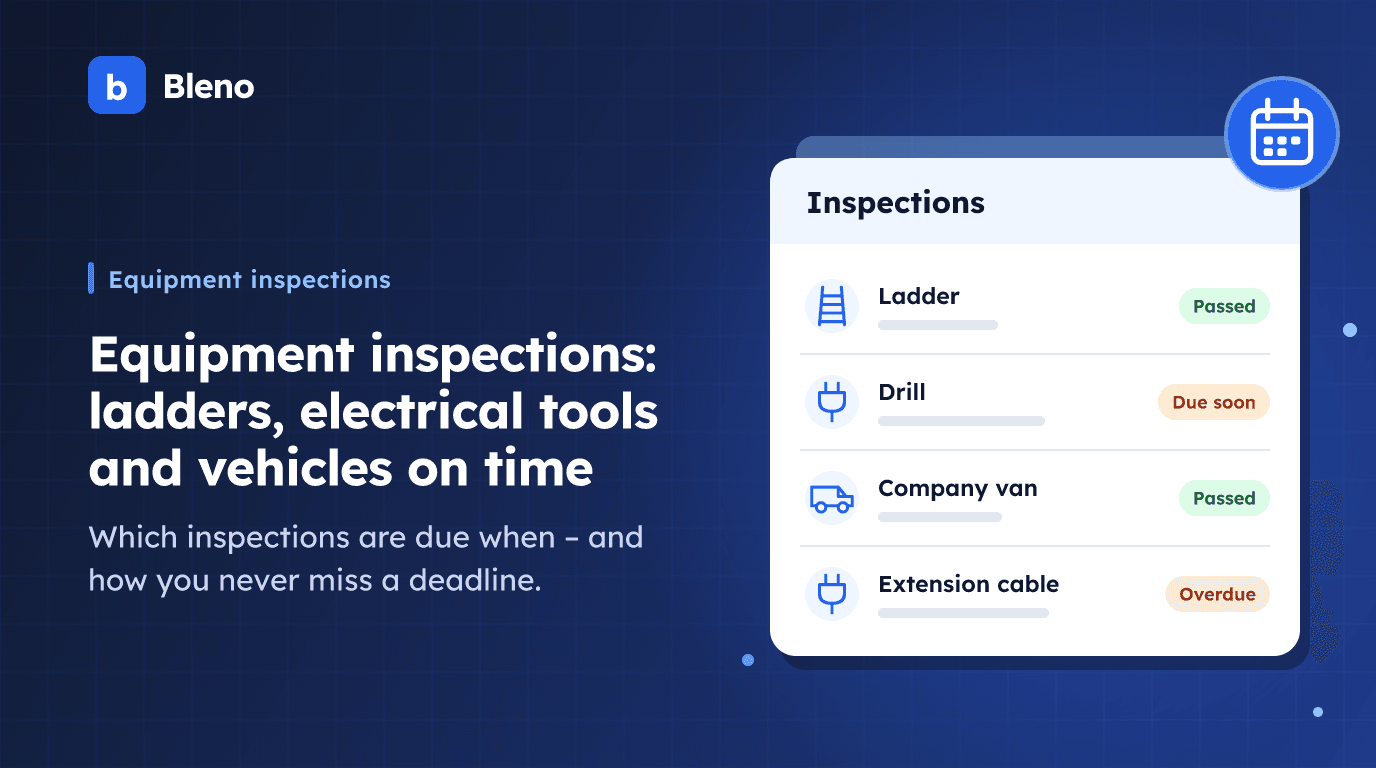
- Everything in one traffic-light view: equipment deadlines appear in the overview with the same traffic light as your employees' records, such as the annual safety briefing.
- Visual check on site via QR code: every device gets a QR label, which you download as an image. Your employees scan it with their phone and land in the equipment file with deadlines, inspection history and open defects. The inspection is recorded with a photo; a defect found is described straight away and appears highlighted in the file and in your equipment overview.
- Reminded in good time: before the due date, the person responsible for the device receives a reminder by push notification and in the app; if there is no responsible person, it goes to the admins. The German UVV inspection and the main inspection of a vehicle appear individually in the weekly records overview.
- Inspection history as a PDF: for an inspection visit by the Berufsgenossenschaft (German accident insurance institution) or for your insurer, "Prüfhistorie als PDF" (inspection history as PDF) downloads all inspections of a device with date, inspector and defects found. A retired device keeps its history and no longer becomes due.
Checklist for your work equipment
- All work equipment subject to inspection recorded and clearly labelled
- Type of inspection and interval set for each equipment group in the risk assessment
- Qualified persons, qualified electrician and competent persons named or commissioned
- Visual check before use explained in the safety briefing
- UVV inspection and main inspection of vehicles planned separately (requirements in Germany)
- Inspection results and defects documented, defective equipment withdrawn
Conclusion
At their core, the inspection obligations for work equipment are simple: set intervals, have inspections carried out by competent people, document the result. What makes it difficult is the volume – many devices, different intervals, different inspectors. If you keep all this in a register with reminders instead of in stickers and spreadsheets, you'll notice due inspections in good time and have the records to hand when they are needed.