Friday, 25 September 2026
Annual safety briefing in Germany: what is required and how to handle it in 10 minutes
Note: This article gives an overview of the legal situation in Germany (as of September 2026) and is not legal advice. Which briefings your business needs, what they cover and how you assess hazards remains your responsibility as the employer – supported by your occupational safety specialist, your company doctor and your German employers' liability insurance association (Berufsgenossenschaft, BG).
In the German trades, the annual safety briefing (Unterweisung) is one of those obligations that everyone knows about and that still tends to get put off. The boss knows it is due, the sign-off sheet is somewhere in the site hut, and at the latest when the Berufsgenossenschaft inspects or after a workplace accident in Germany the question comes up: who was briefed on what, and when? In this article you will learn what is mandatory, what many businesses overlook and how to cut the effort for organisation and records down to about ten minutes.
What German law requires
In Germany, the obligation to give safety briefings is set out in several places:
- German Occupational Safety and Health Act (section 12 ArbSchG): The employer must brief employees on safety and health at work – when they are hired, when their tasks change, when new work equipment or technologies are introduced, and at regular intervals.
- DGUV Regulation 1, section 4 (German accident prevention regulation): The accident prevention regulation of the German Berufsgenossenschaften makes this concrete: a briefing before starting work, then at least once a year, and it must be documented.
- German Young Persons Protection Act (section 29 JArbSchG): Young people under 18, often first-year apprentices, must be briefed at least every six months.
- German Hazardous Substances Ordinance (section 14 GefStoffV): Anyone working with hazardous substances – solvents, adhesives, epoxy resins, wood dust, cleaning agents – must be briefed on them at least once a year, orally and specific to the workplace. Content and date are recorded in writing and confirmed by signature by those briefed.
Depending on the trade, there are further certificates with their own cycles: fall protection equipment for roofers and scaffolders, asbestos competence for work on old buildings, the briefing of qualified electricians, follow-up infection protection instruction in bakeries and butcher's shops. Which of these apply to your business follows from your risk assessment.
What belongs in a safety briefing
A safety briefing is not a lecture read out of a handbook. It should explain the hazards that actually occur at your workplaces and the protective measures you have taken against them. Typical topics:
- Hazards from the risk assessment, such as falls, electricity, noise, dust or hazardous substances
- Protective measures and personal protective equipment, when it is worn and how
- Operating instructions for machines and hazardous substances
- What to do in an emergency, first aid, first-aiders and fire safety assistants in the business
- What has changed since the last briefing: new machines, new types of job sites, accidents and near misses
The form matters: in a language everyone understands, with the opportunity to ask questions. A click in an app or a signature under a text nobody has explained does not replace the briefing. The German Berufsgenossenschaften offer briefing aids for this, for example the BG BAU, the BG ETEM for electrical businesses or the BGHM for metal and wood businesses. You can find the BG responsible for you in Germany via the DGUV overview (German).
What many businesses forget
Most businesses have the annual round in January on their radar. Gaps almost always appear elsewhere:
- New employees: The initial briefing must take place before their first assignment, not at the next annual date.
- Apprentices under 18: The six-monthly cycle applies to them, not the annual one.
- Those absent on the day: Anyone who was ill or on holiday during the joint briefing often slips through the net.
- Trade-specific items with long cycles: The asbestos competence is valid for six years, and the F-gas certificate must be refreshed after seven years. With such long intervals, nobody notices the expiry until a job depends on it.
- Obligations that are not briefings: The six-monthly driving licence check for company vehicles, first-aider refresher training every two years or occupational health check-ups follow the same pattern – cycle, due date, proof – but do not appear on any briefing sheet.
How to keep the records
For documentation, it must be traceable who was briefed by whom, when and on what. A record with the date, topic or content, the name of the person giving the briefing and the signature of every person briefed has proven itself. For hazardous substances, the signature is explicitly required under German law.
There is no fixed statutory retention period in Germany for all briefing records. You should be able to produce them at least until the next briefing; many German Berufsgenossenschaften recommend keeping them considerably longer, because they may still be requested years after an accident. Separate periods apply to health check-ups and certain hazardous substances. Clarify the period for your business with your BG.
How the paperwork gets done in ten minutes
The briefing itself takes as long as it takes – ten minutes of instruction is realistic for one topic, not for several. What can be cut down is everything around it: the list of participants, collecting signatures, chasing up latecomers, maintaining folders. With the Bleno certificates module it looks like this:
- Set it up once (five minutes the first time): You create the obligation, for example "safety briefing, every 12 months, all employees, proof by signature", and store the content as a form template. Bleno creates an open record with a due date for each person, including new starters.
- Brief together, sign together: In the morning before work starts, you launch a group briefing on the tablet. You read out the content and answer questions. Then each person taps their name and signs; before saving, Bleno asks whether the right person really signed. Finally, you sign yourself. For a team of eight, the signatures are done in a few minutes.
- Anyone absent signs on their phone: The record stays open for that person. They read the briefing to the end in the employee app, confirm that they were able to ask questions, and sign – clear up any open questions in person beforehand.
- Bleno sends reminders: Before the next due date, employees get a reminder on their phone, and you as the admin get a weekly overview of what is due or overdue.
- The BG is at the door: Under "Nachweise exportieren" (export records) you generate a ZIP with an overview as a PDF (who completed what and when), the same list as a CSV and all signed records.
Every completed record ends up as a PDF with name, content, date and signature in the digital personnel file. You confirm a driving licence check, a health check-up or a paper first-aid certificate with a date and an optional photo of the certificate.
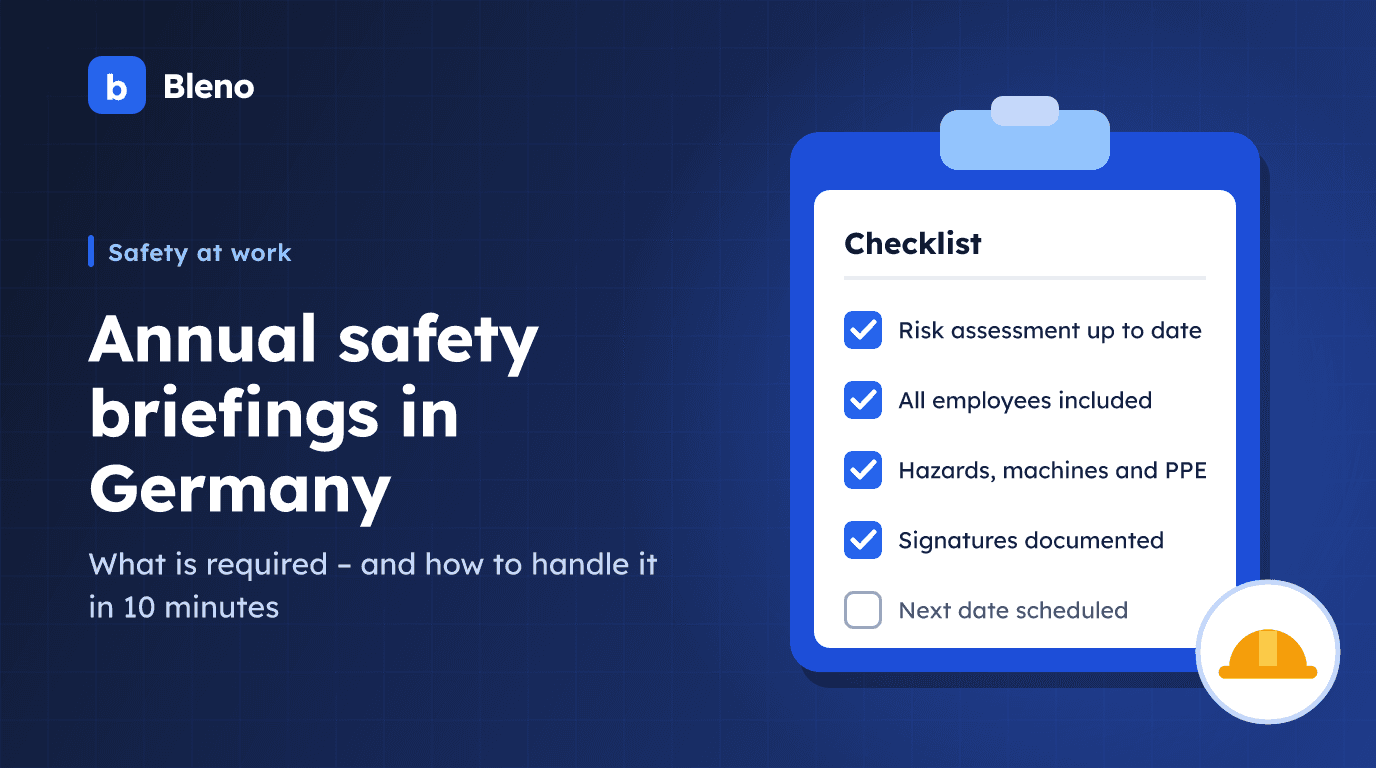
Checklist for your next safety briefing
- Is the risk assessment up to date? What has changed since last year?
- Content prepared, briefing aids from your BG reviewed
- All employees covered, including new employees and apprentices
- Hazardous substances, machines and PPE considered separately
- Time planned for questions, in understandable language
- Signatures of all participants, date and person giving the briefing documented
- Absentees noted and briefed later
- Next date scheduled
Conclusion
In Germany the annual safety briefing is mandatory, and so is the proof of it. It rarely becomes time-consuming because of the briefing itself, but because of the chasing: who is still missing, where is the sheet, when is the next one due? This is exactly the part a digital solution takes off your hands. Responsibility for the content stays with you – Bleno documents, you brief.
You will find more answers in our FAQ on occupational safety and records.