Tuesday, 31 March 2026
Digital signature & customer handover: how acceptance works without paper
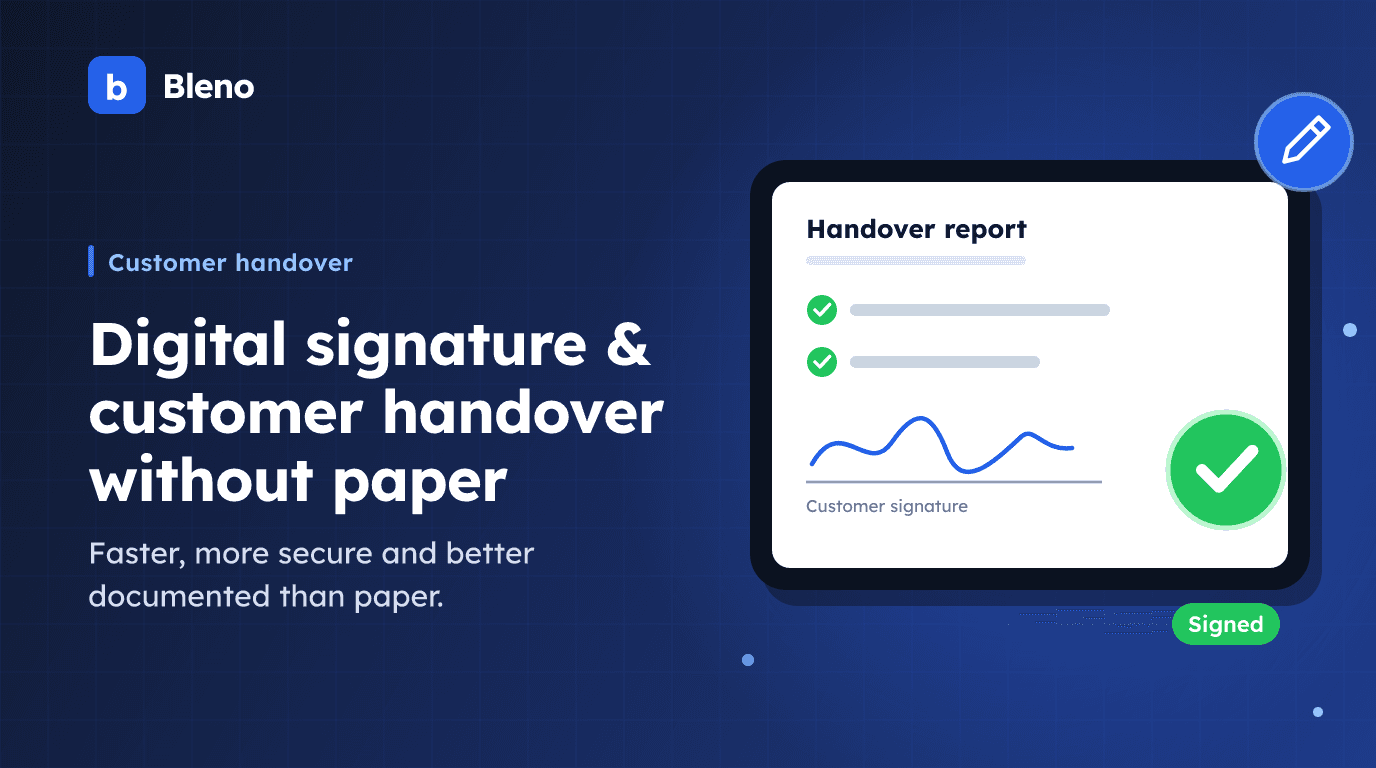
The job is finished, the work is done – now all that's missing is the customer's signature. Sounds simple, but in practice it is one of the most critical moments in the entire digital job process. For businesses in Germany, acceptance of the work under section 640 BGB (German Civil Code) shifts the burden of proof, and the warranty period starts to run.
Anyone who documents sloppily here risks thousands of euros in a dispute.
Why the customer handover matters so much
The following points describe the legal situation in Germany.
Reversal of the burden of proof
Before acceptance, you as the tradesperson have to prove that your work is free of defects. After acceptance, the burden of proof is reversed: now the customer has to prove that there is a defect. This reversal makes acceptance an important safeguard for your business.
Warranty period
The warranty period of 5 years (German Civil Code, BGB) or 4 years (German construction contract rules, VOB/B) only begins with acceptance. Without documented acceptance, in the worst case the period never starts – and in theory you remain liable indefinitely.
Payment falls due
In Germany, your payment only falls due after acceptance. A proper handover report is therefore also the basis for your invoice.
What is a digital signature?
A digital signature (electronic signature) is the electronic counterpart to a handwritten signature. The EU eIDAS Regulation distinguishes three levels:
| Level | Description | Evidential value |
|---|---|---|
| Simple (SES) | Digital input (canvas, touchscreen) | Admissible, but can be challenged |
| Advanced (AES) | Uniquely linked to the signatory | Strong evidential value |
| Qualified (QES) | With a qualified certificate | Equivalent to handwriting |
For acceptance of trade work in Germany, the simple electronic signature (SES) is sufficient. The German Civil Code (BGB) does not prescribe any particular form for contracts for work – acceptance can even be given verbally. A documented digital signature therefore carries considerably more evidential weight than common practice.
Is it valid?
In short: yes.
- Section 126a of the German Civil Code (BGB) expressly recognises the electronic form
- The eIDAS Regulation applies EU-wide and gives electronic signatures legal effect
- German courts accept digital signatures as evidence
- Section 640 of the German Civil Code (BGB) does not require written form for acceptance
What matters is not the type of signature but the evidential value of the documentation. And here digital signatures are superior to paper: timestamp, GPS location and device information make the signature traceable and tamper-evident.
How a digital customer handover works
This is how customer handover works with Bleno:
1. Create a handover report
Create a handover report for the project. Project and customer details are pulled in automatically from your records.
2. Describe the work
Describe the work carried out that is to be accepted.
3. Document defects
If there are defects: document each defect with description, severity (minor / significant / critical), photo and deadline for remedy.
4. The contractor signs
You as the contractor sign directly on the tablet or smartphone.
5. The customer signs
The customer signs either:
- Directly on your device – if you are on site
- Via a link – by email or messenger. The customer doesn't need a Bleno account and can view and sign the report on their own device.
6. The PDF is created automatically
Once both have signed, the report is locked and an unalterable PDF is created. Both parties receive a copy.
Advantages over paper
- Speed: No printing, signing, scanning, emailing
- Evidential value: timestamp + GPS + SHA-256 hash > illegible handwriting
- Flexibility: The customer can also sign later via link
- Security: The PDF cannot be changed after signing
- Traceability: Who signed when and where? Everything documented
Practical tips
-
Keep a tablet ready: A tablet with a large display makes signing more comfortable than a smartphone.
-
Document defects straight away: Photograph every defect during the inspection. Bleno saves the photos with timestamp and GPS.
-
Use the link option: If the customer isn't on site or wants to "have another look", send the signature link by email. The link is time-limited and secure.
-
Send the PDF straight away: Send the customer the PDF copy directly after acceptance. That builds trust and avoids discussions later.
-
Use templates: Bleno provides a ready-made handover report with all the necessary fields. You just fill it in.
How Bleno implements digital signatures
Bleno offers:
- Canvas-based signature directly on the touchscreen
- SHA-256 integrity hash for every signature
- GPS + timestamp + device information as metadata
- Customer link without an account – time-limited, optimised for mobile
- Automatic PDF creation after signing
- Tamper-evident audit trail to support VOB compliance for businesses in Germany
Conclusion
The digital signature is not only more convenient than paper – it also carries more evidential weight. Timestamps, GPS data and hash values make every signature traceable and tamper-evident. For trade businesses that means better protection with less effort.
Try Bleno free for 14 days and see how easy digital customer handover can be. No credit card required. Get started.
More about the feature: digital signature in Bleno