Saturday, 11 April 2026
Updated on 20 October 2026
Software for electricians: site measurement, quotes and documentation done digitally
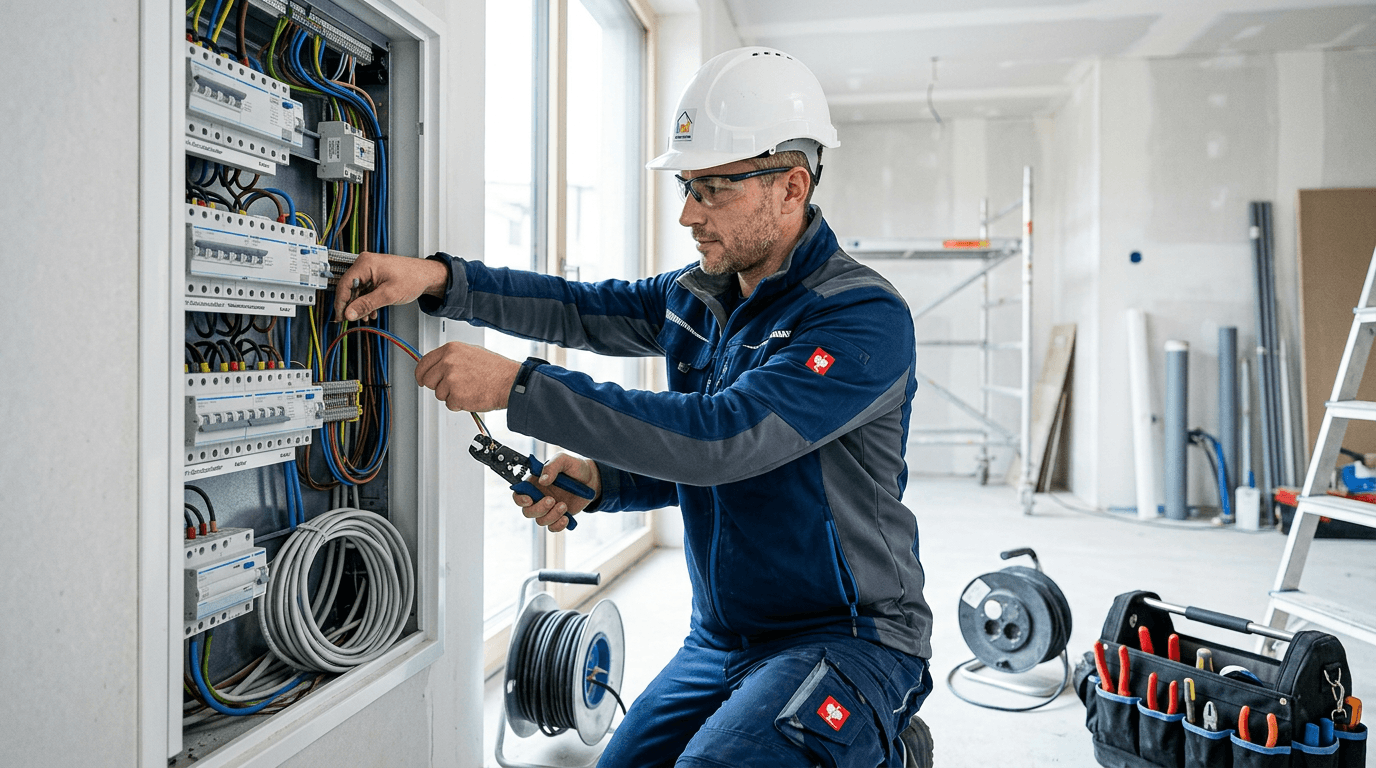
Electrical businesses work differently from other trades: several technicians are on different sites every day, the range of materials is enormous, and at the end the as-built documentation has to be right – otherwise there's no acceptance. At the same time, many electrical businesses still manage their jobs with Excel, email and paper.
In this article we show which software features are particularly relevant for electrical businesses – and how digital tools make everyday work easier.
The specific challenges of electrical businesses
Many technicians, many sites
A medium-sized electrical business often has 5–15 electricians working on different sites every day. Who is where? How many hours have been booked? Is the project on schedule?
Without a digital tool: daily phone calls, manual time sheets, incomplete information.
A wide range of materials and frequent orders
Cables, wiring, switches, fuses, terminals, junction boxes – the materials list for an electrical project can have hundreds of items. Prices change, suppliers have different terms.
If you don't manage materials in a structured way, you lose track of costs.
GAEB tenders in the public sector in Germany
Public buildings in Germany – schools, town halls, administrative buildings – regularly put their electrical work out to public tender. GAEB files (the German tender format) have to be imported, priced and sent back.
Without software for the German GAEB format: hours of typing per tender.
As-built and site documentation
At the end of a project, cable routes, wiring diagrams and installed components must be documented. Without structured documentation, this data is missing – or sits in private phone photo albums.
Which software features matter most for electricians
1. Digital site measurement on site
An electrician measures cable lengths, room dimensions and the number of junction boxes. With digital site measurement, these values are recorded directly in the app – cable quantities and material requirements are calculated automatically.
Result: no retyping, no transcription errors, a materials list in minutes instead of hours.
2. Quotes with electrical price lists
The price list from the supplier catalogue is stored in the software. Materials are selected by search, not typed in. Quantities and prices are up to date.
Result: quotes created in half the time, with fewer errors.
3. GAEB import and export for public contracts in Germany
A GAEB X83 file from the client is imported – all items are immediately available in Bleno. After you enter prices, the GAEB X84 file is exported and submitted. You can read how this works in detail in Handling GAEB tenders with software for trade businesses (about public tenders in Germany).
Result: instead of hours of typing: minutes to import and price.
4. Time tracking for several electricians on different sites
Each electrician clocks in in the morning and selects the project. The boss sees live who is on which site and how many hours have been booked. At the end of the project, the real hours are ready for job costing.
Result: no time sheet chaos, precise project hours for billing.
5. Site documentation for as-built records and warranty
Cable routes behind the wall, the position of junction boxes, the condition before opening up – everything is photographed with a smartphone and saved directly in the project.
Result: as-built documentation always complete, warranty claims clearly rebuttable.
6. E-invoicing for business clients in Germany
Since 2025, B2B clients in Germany have been required to accept e-invoices. With ZUGFeRD-compliant invoices from Bleno, electrical businesses in Germany meet this requirement without extra effort.
A typical electrical business: a week with and without software
Without software (3 electricians, 4 sites):
- Monday: collect and type in last week's time sheets (1.5 h)
- Wednesday: type in a German GAEB tender by hand (4 h)
- Thursday: create a quote, search for and type in materials manually (3 h)
- Friday: create invoices, gather figures (2 h)
- Total office time: ~10.5 h
With Bleno:
- Monday: check and confirm hours (0.25 h)
- Wednesday: import the German GAEB file, enter prices (1 h)
- Thursday: create a quote with catalogue selection (1.5 h)
- Friday: generate invoices (0.5 h)
- Total office time: ~3.25 h
That's 7 hours a week freed up for productive work.
Which businesses benefit most
Bleno is particularly suitable for electrical businesses that:
- regularly handle GAEB tenders (in Germany)
- coordinate several electricians on different sites
- use materials from supplier catalogues
- have to produce as-built documentation for customers
- want to move away from Excel or paper-based processes
Conclusion: digital tools aren't a luxury for electrical businesses – they're a competitive advantage
An electrical business that can handle GAEB tenders in Germany quickly, create quotes in half the time and evaluate hours without time sheet chaos can take on more jobs – without more staff.
In a market with a shortage of skilled workers, that's not a detail. It's a survival strategy.
You can see how Bleno specifically supports electrical businesses on the page Software for electricians.
Try Bleno free for 14 days and discover what digital tools can do for your electrical business. Get started.