Wednesday, 30 September 2026
Dunning in the trades in Germany: using payment reminders, dunning levels and default interest correctly
Note: This article gives an overview of the legal situation in Germany (as of September 2026) and is not legal advice. For disputed claims, construction contracts with special agreements or before taking court action, please talk to your lawyer or your chamber of crafts (Handwerkskammer).
The work is done, the invoice has gone out – and then nothing happens. In the trades this is everyday life: materials and wages were paid long ago, the money from the customer is still missing. If you do not follow up consistently, you are financing your customers interest-free. At the same time, nobody wants to put off a good regular customer with a sharp dunning letter just because the transfer was forgotten during their holiday. In this article you will learn when a customer is legally in default in Germany, what you can charge, what a sensible process looks like and how to automate it.
When is a customer in default?
Default in payment is governed in Germany by section 286 of the German Civil Code (BGB). It matters because default interest and reimbursement of dunning costs only become due once the customer is in default. There are three typical routes:
- Through a dunning letter after the due date: The classic. The invoice is due, you send a reminder, and the customer is in default from the moment it is received. Legally, even a friendly payment reminder already counts as a dunning letter under German law if it clearly demands payment.
- Through a calendar date: If the invoice states a specific payment date ("payable by 15 October 2026"), under German law the customer is usually in default without a reminder if they have not paid by then. Wording such as "payable within 14 days", on the other hand, is not always clear enough.
- Through the 30-day rule: At the latest 30 days after the due date and receipt of the invoice, the customer is in default even without a reminder (section 286(3) of the German Civil Code, BGB). For private customers this applies only if you explicitly point out this consequence on the invoice. A sentence in the invoice text is enough, for example (translated from German): "If payment is not made within 30 days of receipt of this invoice, you will be in default even without a reminder."
For construction work in Germany there is an additional point: the final invoice generally only becomes due upon acceptance and an invoice that can be checked (section 650g BGB, and for German VOB/B contracts section 16 VOB/B). No due date, no default – clean acceptance is therefore also important for dunning.
How many dunning levels make sense?
German law does not prescribe a particular number of reminders. A single dunning letter is enough to trigger default, and nobody has to send three reminders before starting court dunning proceedings. In practice, though, a staged process has proven itself because it protects the customer relationship:
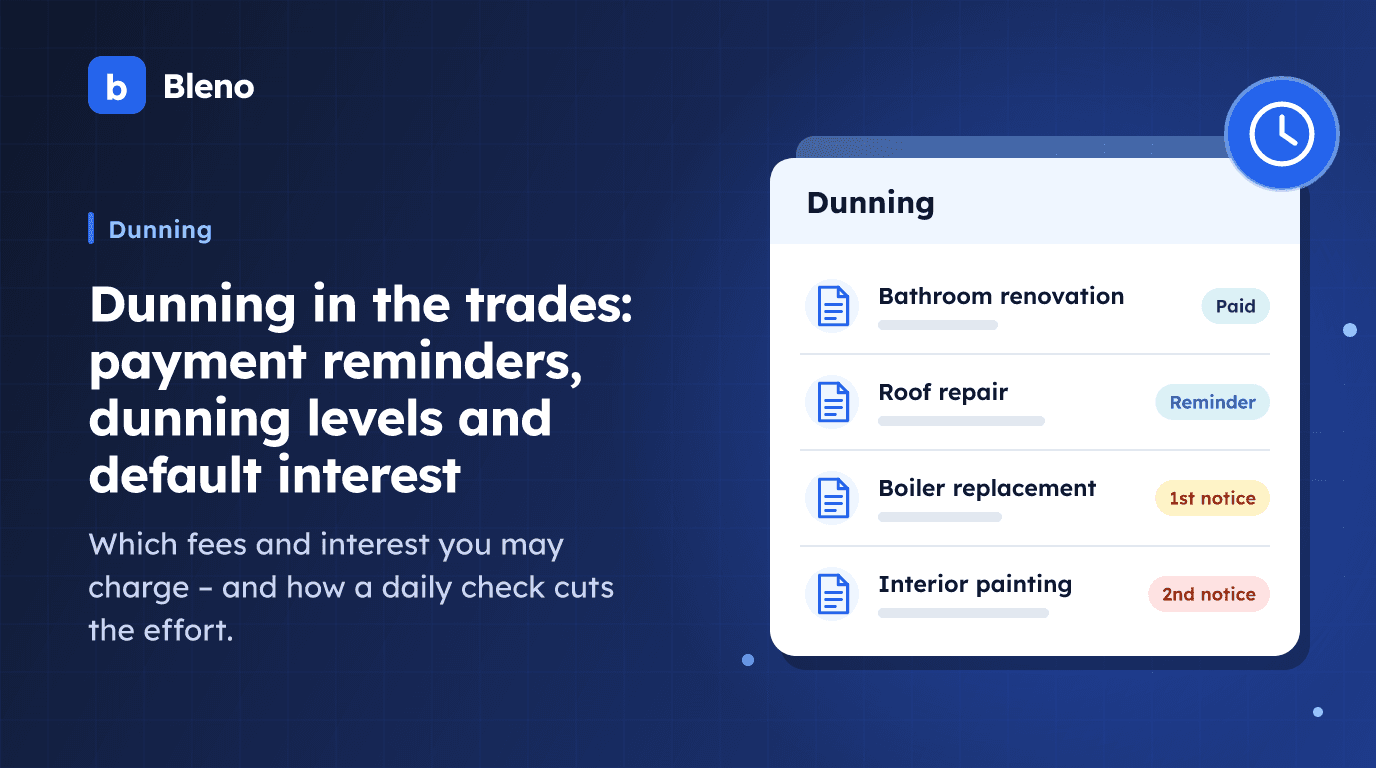
- Payment reminder about a week after the due date: friendly, without fees, noting that the letter can be disregarded if payment has already been made.
- 1st dunning letter around two weeks later: factual, with a new payment deadline and default interest where applicable.
- 2nd dunning letter with a clearer tone and a short deadline.
- Final dunning letter announcing the next steps, such as debt collection or court dunning proceedings.
More important than the number of levels is that you always follow the process in the same way. If you sometimes send reminders and sometimes don't, you teach your customers that the payment deadline is not meant seriously.
Dunning fees: less than many think
In the German trades, amounts of 5, 10 or 15 euros per dunning letter are often quoted as dunning fees. Legally, the picture under German law is more sober: only the damage actually incurred has to be reimbursed, such as postage, paper and printing. According to prevailing case law in Germany, your own working time for writing the letter is not included. Flat fees are disputed; courts usually recognise only a few euros. In addition: the first reminder that actually triggers default cannot be reimbursed, because before it the customer was not yet in default.
So rather charge a realistic, small fee from the dunning letter that is sent after default has occurred than a high flat fee that will not stand up in a dispute anyway and will annoy the customer.
Default interest and the 40-euro flat fee
Default interest under section 288 of the German Civil Code (BGB) brings in considerably more:
- Private customers (consumers): 5 percentage points above the base rate per year.
- Business customers (companies): 9 percentage points above the base rate per year.
- Flat-rate default fee: For business customers you can also charge a flat 40 euros (section 288(5) of the German Civil Code, BGB). This flat fee is offset against later legal costs, for example for a lawyer. It does not exist for private customers.
The base rate is adjusted on 1 January and 1 July and published by the Deutsche Bundesbank (Germany's central bank). Interest accrues daily on the outstanding amount from the date of default.
When nothing else works: court dunning proceedings
If the customer still does not pay after the final dunning letter and does not dispute the claim, court dunning proceedings (gerichtliches Mahnverfahren) in Germany are the quick and inexpensive route to an enforceable title. You file the application online with the competent central German dunning court; you do not need a lawyer. If the customer does not object to the payment order, you apply for the enforcement order. If they object, the matter goes into normal court proceedings.
One point many underestimate: dunning letters do not stop the limitation period. Under German law, claims for payment for work generally become time-barred after three years, counted from the end of the year in which they arose. A court payment order suspends the limitation period; your own dunning letter does not.
Tips so that it never gets that far
- Clear payment deadlines: A specific date on the invoice is clearer than "payable immediately" or "within 14 days".
- A note on the 30-day rule on every invoice to private customers in Germany.
- Invoice quickly: The longer ago the work was done, the lower the willingness to pay. An invoice on the day of acceptance is ideal.
- Interim invoices: For larger jobs in Germany you can request instalments for work already performed under section 632a of the German Civil Code (BGB). This reduces your risk considerably.
- Make paying easy: A payment QR code (GiroCode) on the invoice saves the customer from typing in the IBAN and payment reference – and saves you payments without an invoice number.
- Make a quick call: With good customers, a phone call before the 2nd dunning letter often clarifies more than any letter – for example a complaint you did not yet know about.
How Bleno automates your dunning
With dunning in Bleno you set up the process once and afterwards only need to approve:
- Define the levels once: Under "Einstellungen → Mahnwesen" (Settings → Dunning) you store the deadline, new payment deadline, subject, text and – if you wish – a dunning fee for the payment reminder and dunning letters 1 to 3. Fees are off by default. If you wish, Bleno calculates default interest under section 288 of the German Civil Code, BGB (private customers +5, business customers +9 percentage points) and, for business customers, optionally the 40-euro flat fee.
- Daily dunning run: Every morning Bleno checks your overdue invoices and creates the next due level as a dunning suggestion. Under "Angebote & Rechnungen → Mahnvorschläge" (Quotes & invoices → Dunning suggestions) you see customer, invoice, level, outstanding amount, fee and interest, including a PDF preview, and approve them individually or all with one click. You can skip or postpone individual suggestions.
- No embarrassing reminders: The run leaves out invoices with a recent incoming payment or an open payment suggestion in bank reconciliation; for partial payments, only the remainder is dunned. In the case of a complaint or an agreed instalment plan, you set a dunning block with a reason on the invoice or on the customer.
- A clear dunning letter with a statement of the claim: Each dunning letter goes to the customer as a separate PDF together with the invoice – with the outstanding amount, amounts already paid, fee, interest, total claim and GiroCode. The payment QR code also appears on your invoices.
- Fully automatic if you wish: If you switch on "Mahnungen automatisch versenden" (send dunning letters automatically), the dunning run sends the due levels itself in the morning. For each level you decide what goes out automatically – for example the payment reminder automatically, while dunning letters still need your approval. By default, everything waits for your approval.
- Transparent for the customer: In the customer portal, your customer sees the current dunning level with the payment deadline for open invoices and can download every dunning letter as a PDF.
Conclusion
Good dunning is not distrust of customers, it is simply order: clear payment deadlines, a fixed process, realistic fees and default interest where you are entitled to it. It only becomes time-consuming if you have to keep track of every overdue invoice yourself. Software takes over that part – the decision about whom you remind and how stays with you.